Category: Knit Design Resources

  • Knitting Patterns and Copyright

    Knitting Patterns and Copyright

    The broadest Creative Commons license is Attribution (CC BY). It grants users all of the same rights as the original creator, as long as the creator is given credit for creating the original work. All CC licenses begin with and include Attribution, but limit the user’s’ rights to share, adapt, or profit from the work in some way.

    The Attribution-ShareAlike license (CC BY-SA), allows adaptations and commercial use, but requires all users to share their work with the same license as the original.

    The Attribution-NonCommercial license (CC BY-NC), allows adaptations but prohibits users from using the work or any derivatives for profit or other commercial purposes.

    The Attribution-NoDerivatives license (CC BY-ND) limits users ability to change or adapt the work except for personal use, but the license does not restrict the user’s rights to distribute the work, including for sale or for other commercial purposes.

    The Attribution-NonCommercial ShareAlike license (CC BY-NC-SA) grants the right to adapt the work provided it is shared with the same license. This license does not allow users to profit from or otherwise use their adaptations commercially.

    The Attribution-NonCommercial No-Derivatives license (CC BY-NC-ND) grants only the right to use the work and does not allow adaptations, derivatives, or commercial use.

    What license might a knit designer use if they are offering a pattern for free? Susanna IC has a copyright notice on her website. The license for all her free patterns is CC BY-NC, so users can adapt and share the work with attribution, but not for profit or other commercial purposes.[2] She retains the copyright for all her paid patterns.

    Another knit designer, Laura Semesky, has granted users the CC BY-NC-SA license for her Winter Is Coming scarf pattern, which allows users to use and adapt the work non-commercially as long as they credit the designer and share the adaptations with the same license as the original.[3]

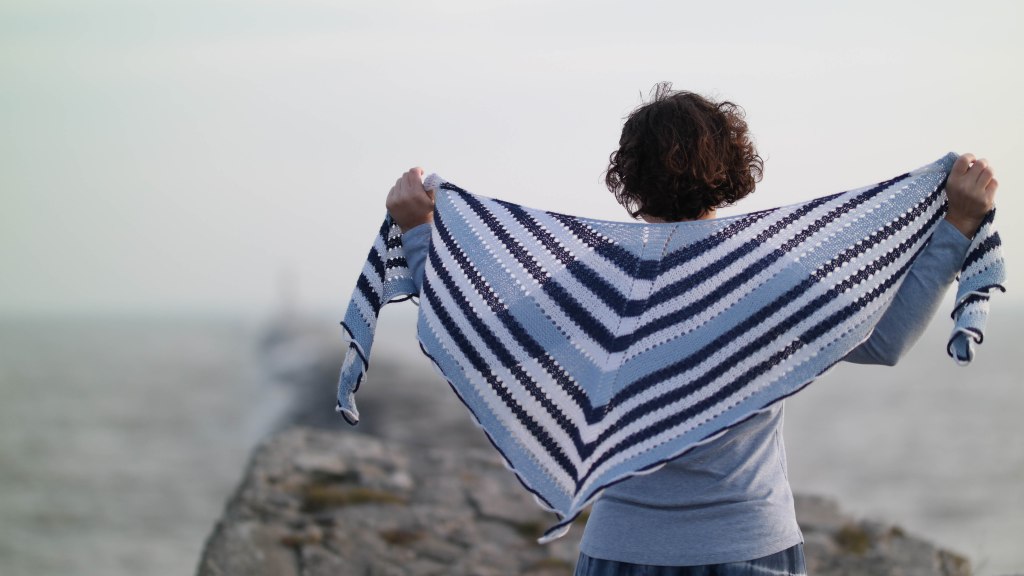
    I have just amended my free Voyager Shawl pattern to have the CC BY-NC-SA license also. I developed this pattern the same way as all my others, with tech editing and test knitting, but I made it free so people could see an example of my work in my portfolio.

    There are a lot of free knitting patterns available, but many of them don’t use Creative Commons licenses. This could be because the designers are unaware of these licenses, but we shouldn’t assume so. The designers may just want to retain all their rights as the copyright holder.

    Some designers use free patterns to drive traffic to their websites, or as a thank you for signing up for their mailing list, both commercial purposes that are protected by copyright.

    With the large number of free knitting patterns on the internet it’s important that knitting pattern creators and users understand copyright and Creative Commons licenses. Check out the Creative Commons website to find out more.


    [1] Office, U. C. (n.d.). What is Copyright? | U.S. Copyright Office. https://www.copyright.gov/what-is-copyright/

    [2] ArtQualia | Designs by Susanna IC | Copyright Notice. artqualia.com/copyright%20notice.html.

    [3] “Winter Is Coming Pattern by Laura Semesky.” Ravelry, http://www.ravelry.com/patterns/library/winter-is-coming-9.
  • Knitting Seamless Sweaters; Four Construction Methods

    Knitting Seamless Sweaters; Four Construction Methods

    I have been a seamless knitter from the start, and I’ve often heard statements like “seams add structure” and “seamless knits will stretch out of shape.” As with most things, it depends. If you knit a garment at a loose gauge in a yarn with no memory it will probably stretch out of shape with or without seams. If structure and rigidity are what you want, hand knitting may not be the best method for creating your garment. Although you can create knit fabrics with more structure by working stranded colorwork or a slip-stitch pattern at a dense gauge, you may consider creating your garment out of a stiff woven fabric instead.

    Knit fabric is very flexible and fluid and can be shaped 3-dimensionally as the fabric is created. Rather than seeing the flexible property of knit fabric as an obstacle to overcome, I look at it as an advantage to be utilized. Knit fabric looks the same whether it is worked flat or circularly (unlike crocheted fabric) and pieces can be joined invisibly (unlike woven fabric). Seams alone will not make knit fabric behave like woven fabric, but it’s not true either that seamless knits will always stretch out of shape over time. Well-fitting, thoughtfully constructed knit garments will be both comfortable and flattering for years of wear, and constructing whole garments without a single seam is like magic!

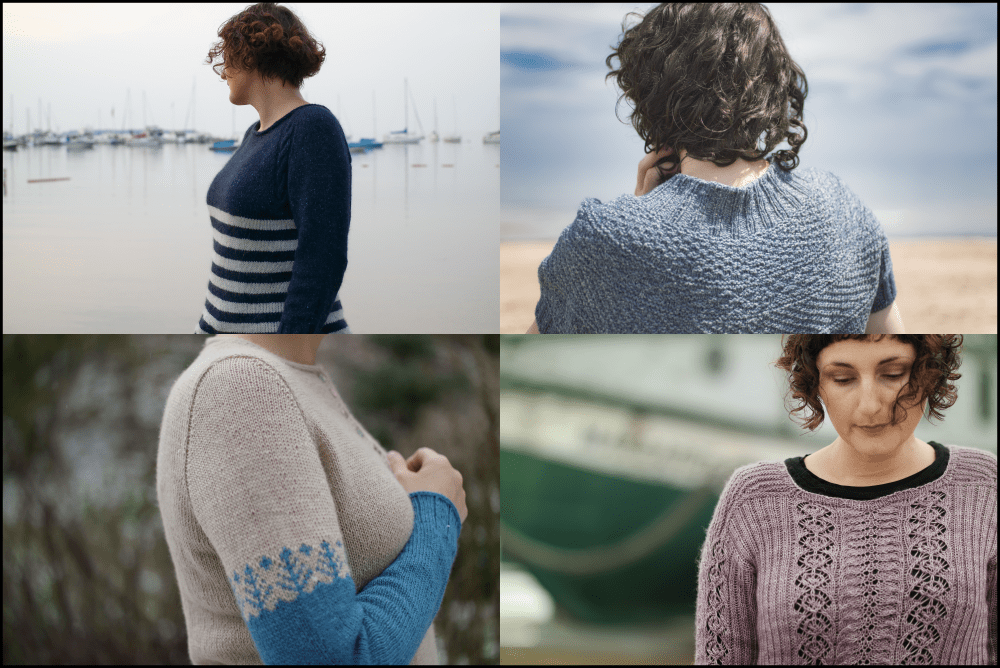
    The most crucial aspect of garment construction is the way the sleeves fit into the shoulders of a garment. This section of a garment can be referred to as the yoke, regardless of construction. Most construction methods can be worked seamlessly from the top down or the bottom up, simply by swapping increases for decreases. The main types of shoulder and sleeve constructions are: drop shoulder, raglan, round yoke, and set-in sleeve. In this post I’ve listed the characteristics of each one, and common problems to look out for when knitting and designing them.

    Raglans

    Raglan yokes have a characteristic diagonal line between the shoulder and sleeve join. Although top-down raglans have become very popular, raglans can also be made seamlessly from the bottom up, or in pieces and seamed. It’s the diagonal join that makes it a raglan. The standard increase or decrease rate for a raglan yoke is 8 stitches every 2 rows or rounds; 2 stitches at every raglan line. This ratio works well for sizes with a chest circumference of around 40″/100 cm but will result in armholes that are too deep and neck circumferences that are too wide in larger sizes. Smaller sizes can have the opposite problem. To create a better fitting raglan a faster rate of increase, like 12 or 16 stitches for every 2 rows/rounds, can be used at the top to ease over the shoulders and at the bottom to curve around the underarms. If your size does not fall in the middle of the size range look for this type of saddle/raglan hybrid for a better fitting sweater.

    Round Yokes

    This is a great construction for people with a non-standard bust-to-upper-arm ratio because there is no distinction between body and sleeves until the bottom of the yoke. Stitches can be borrowed from the body and moved to the sleeves for larger arms, or vice versa to accommodate a larger bust. Round yokes are shaped with several sets of increase or decrease rows or rounds, or sometimes in wedges. The shaping rounds should be more frequent near the neck opening to accommodate the width of the shoulders, with most of the shaping rounds occurring in the top half of the yoke. If the shaping rounds are evenly distributed throughout the yoke it will result in a cone-shaped yoke, causing the sweater to ride up at the neck because the circumference of the fabric isn’t large enough to fit around the shoulders.

    Drop Shoulders

    The drop shoulder is a really simple construction that’s great for oversized or unisex sweaters. The shoulder line is meant to fall at the upper arm, not the shoulder break, so this style will work well for people with broad or narrow shoulders without any adjustments. One problem you might encounter with this style is sleeves that are either too long or too short. The top of the yoke forms part of the sleeve, so the length of the sleeve depends on how far down the arm the shoulder extends. Knitting the sleeves directly onto the sweater by picking up stitches around the armhole allows the sweater to be tried on and the sleeve length adjusted for a perfect fit.

    Set-In Sleeves

    Set-in sleeve construction follows the shape of the body more than the other styles. To get a really good fit the line where the sleeve is set into the shoulder should fall right at the shoulder break; where the shoulder bends when you extend your arm to the side. Because of this, it’s best to choose your size based on your shoulder width rather than chest circumference, and then make adjustments for the difference. Casting on extra stitches at the front neck when working from the top down, or decreasing additional stitches at the front neck when working from the bottom up can create extra fabric at the chest to accommodate a larger bust and narrow shoulders.

    Seamless set-in sleeve yokes can be worked in one piece from the bottom up or top down using decreases or increases to shape the sleeve cap and armhole simultaneously, or the front and back of the yoke can be shaped first with stitches picked up around the armholes and shaped with short rows to create the sleeve caps. Both methods can create a set-in sleeve yoke with a smooth shoulder and sleeve join that follows the curve of the shoulder joint and the underarm.

    I hope that this overview will inspire you to create seamless sweaters that fit your unique body shape and proportions, and embrace the inherent properties of knit fabric! What is your favorite sweater construction? Is there a particular modification that you always make to help your sweaters fit better? Please leave a comment!

    Thank you for knitting!

  • Ease

    Ease

    What Is Ease?

    Ease is the term used to describe the difference between the size of a garment and the size of the body the garment is intended to fit. There are two types of ease used in garment design–wearing ease and design ease. Wearing ease is necessary for movement in places like the underarm and elbow. Whether the garment is designed to wear over other clothing or just undergarments will also help to determine how much wearing ease is needed. Design ease determines the shape and fit of a garment. A batwing sweater will have a lot of ease at the underarm and chest while a set-in sleeve sweater will usually have only a small amount of ease. In a bulky sweater the thickness of the fabric will take up some of the ease between the outer circumference of the sweater and the circumference of the body. Some garments can be worn with negative ease for a form-following fit because of the inherent stretch of knit fabric.

    Some general guidelines regarding ease and fit:

    • Very close fit – 0 to 2″/5 cm negative ease
    • Close fit – 0 to 2″/5 cm positive ease
    • Standard fit – 2 to 4″/5 to 10 cm positive ease
    • Loose fit – 4 to 6″/10 to 15 cm positive ease
    • Oversized fit- 6″/15 cm or more positive ease
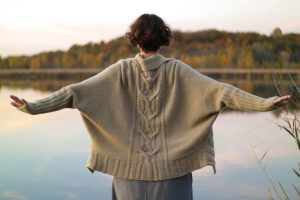
    Augusta is a cocoon-style cardigan with a lot of design ease at the underarm.
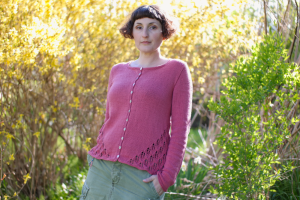
    Kephren wearing the Spring Thaw Cardigan with zero ease
    The Spring Thaw Cardigan is a set-in sleeve sweater worn with zero ease at the bust.

    How To Determine Your Preferred Ease

    Ease is ultimately a matter of personal preference. Some people like to wear their sweaters with a lot of ease and others prefer no ease at all. The amount of ease suggested in a pattern is just a suggestion, based on a theoretical range of body sizes. Every knitter will not fit neatly into one of these sizes. When I am grading a knitting pattern I apply the same amount of intended ease to each size to maintain a consistent fit across the size range, but the amount of ease the garment is worn with is ultimately up to the knitter. Hand knitting is wonderfully customizable, and knitters can choose the amount of ease they prefer. An evenly graded size range, a schematic, and finished measurements will make it easier for knitters to achieve the fit they want.

    To determine how much ease you prefer, measure the width of a sweater that you like the fit of at the bust/chest and multiply the width by 2 to get the circumference. Then measure your body around the fullest part of your bust/chest. Subtract your body measurement from the sweater measurement. This is your preferred ease and corresponds to the suggested ease given in a pattern. If a pattern suggests 6″ to 8″/15 to 20 cm of ease but you know from your measurements that you prefer 2″/5 cm of ease, you may want to knit one size smaller than suggested for your chest measurement.

    It’s also important to get the right amount of ease at the upper arm. Measure the width of your sweater’s sleeve just below the underarm and multiply by 2 to get the circumference, then measure around your arm just below the underarm. Subtract your arm measurement from the sweater measurement to determine how much ease you like in your sleeves. Now look at the upper arm circumference of the pattern size you chose. If the pattern’s sleeve circumference is the same as your well-fitting sweater, that’s perfect! If the upper sleeve circumference is different from your preferred sleeve circumference you may want to choose a different size or adjust the circumference of the sleeve. Negative ease in the sleeves will make them ill-fitting and uncomfortable.

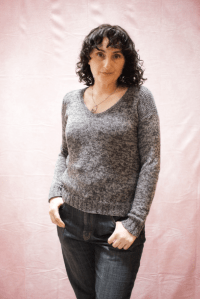
    The Lake Geneva Sweater shown in size 35 1/4″/89.5 cm and worn with 2″/5 cm negative ease.
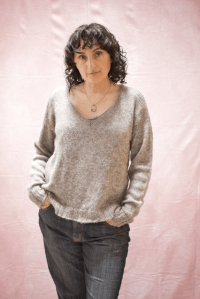
    The Lake Geneva Sweater shown in size 43 3/4″/111 cm and worn with 6″/15 cm positive ease.

    Ease and Bust Size

    You can see from my two versions of the Lake Geneva Sweater above that the same garment can look very different depending on the amount of ease it’s worn with. Ease is calculated at the full bust, so the size of your bust relative to the rest of your torso will also affect the amount of ease in your garment. My high bust measurement (measured around my chest just below the underarms) is 34 1/2″/87.5 cm and my full bust is 38″/96.5 cm. The smaller version, worn with negative ease at the bust, still has some positive ease in the sleeves and body because my full bust is 3 1/2″/9 cm larger than my high bust, and most standard women’s size charts assume a B cup, or a full bust 2″/5 cm larger than your high bust. If you wear a C or D cup, or your full bust is 3″ to 4″/7.5 to 10 cm larger than your high bust, you may need less ease at the full bust to achieve your preferred fit everywhere else. If your cup size is larger than DD or 5″/12.5 cm larger than your high bust, you may wish to make a smaller size than recommended to fit the rest of your body and add extra fabric at the bust only with additional rows or stitches in the front of the garment.

    The Relative Ease Fallacy

    There have been some discussions recently about whether larger people need to have more ease in their garments to achieve the same look and fit as smaller people wearing the same type of garment. I think this idea is based on false assumptions and a misunderstanding of geometry. Remember, ease is the difference between the body measurement and the garment measurement. If the same amount of ease is applied to each size in the range, the difference between the body and garment measurements will remain the same.

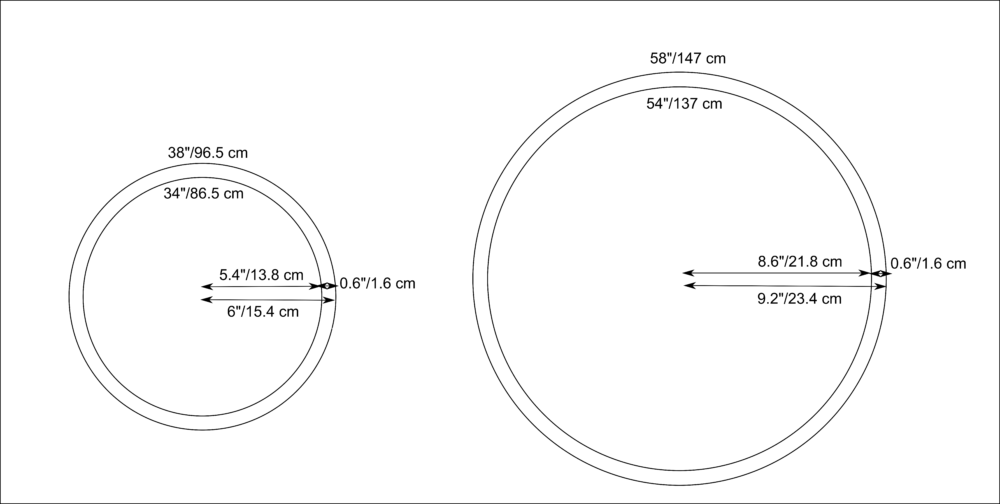
    Two pairs of circles demonstrating how ease remains the same when applied consistently. A 34"/86.5 cm circle within a 38"/96.5 cm circle has a 0.6"/1.6 cm radius difference, and a 54"/137 cm circle within a 58"/147 cm circle also has a 0.6"/1.6 cm radius difference.

    The two pairs of circles above illustrate what happens when the same amount of ease is applied to two different size garments. Imagine that the inner circle is the body and the outer circle is the garment. I calculated the radius of each circle in the pair and subtracted the radius of the smaller circle from the larger one. The difference between the outer circle and the inner circle is the ease. It is not relative to the size of the circles and stays exactly the same as long as the difference in the circumferences stays the same. This is why relative ease doesn’t work. You will not achieve the same fit by applying different amounts of ease across the size range. Notice also that even though the outer circle is 4″/10 cm larger than the inner circle, the difference between the radii is only about 1/2″/1.5 cm.

    How much ease do you prefer? Do you usually follow a design’s suggested ease? Tell us about it in the comments!

    Resources

  • Estimating Yardage

    Estimating Yardage

    Have you ever wondered how designers arrive at the recommended yardage listed in a pattern? Are you designing a sweater and wondering how to accurately list the yardage for sizes that haven’t been knit yet? Or maybe you are changing the gauge or length of a sweater you’re knitting and want to make sure you don’t run out of yarn? In all of these situations you can estimate how much yarn you’ll need using a swatch, a kitchen scale, the information from your yarn’s ball band, and a calculator or spreadsheet. This is how I do it.

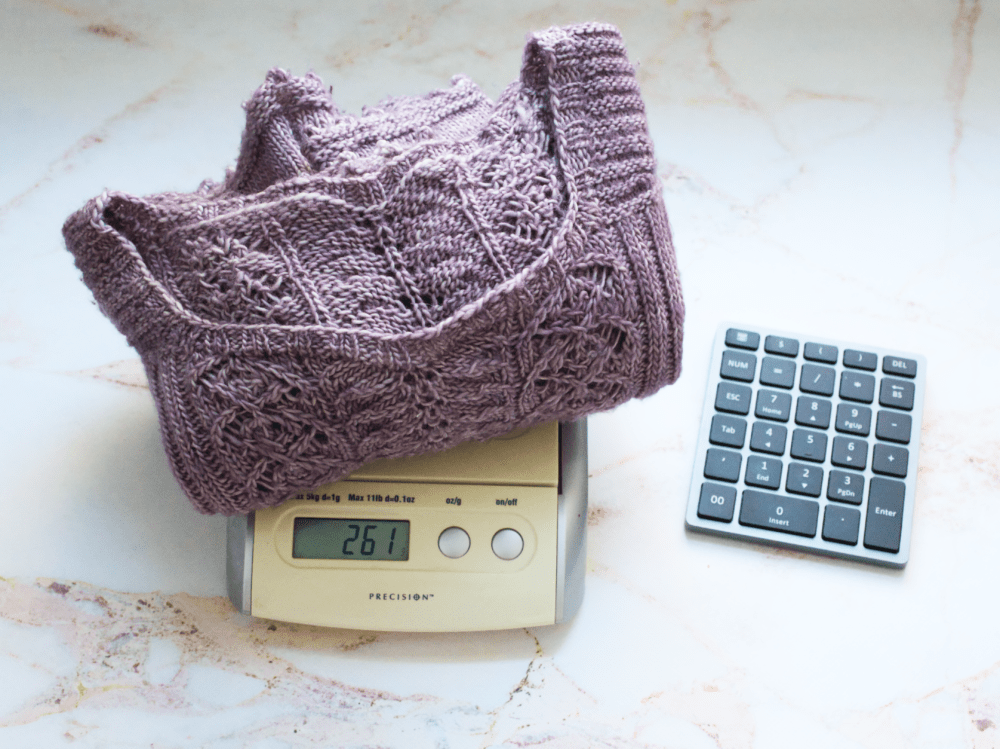
    First, determine how much yarn it takes to make a square inch or square centimeter of your knitted fabric. You can start with a large rectangular swatch or an entire garment. Weigh your swatch or sample using the kitchen scale. I like to use the weight in grams because it’s a smaller unit of measure than ounces, and ball or skein weights are usually given in grams.

    Next, determine the area of your swatch or sweater. If your swatch is a square or rectangle you can multiply the length by the height to determine the area. For example, if your swatch measures 8 x 8 inches the area is 64 inches. (If you’re more comfortable with metric go ahead and use centimeters for all measurements instead.) Divide the area by the weight. Let’s say your swatch weighs 10 grams. 64/10 = 6.4. It takes 1 gram of that particular yarn to make 6.4 square inches of that particular fabric. If you wanted to add 2 inches in length to a sweater with a circumference of 40 inches that’s 80 square inches. 80/6.4 = 12.5. You would need an additional 12.5 grams of yarn.

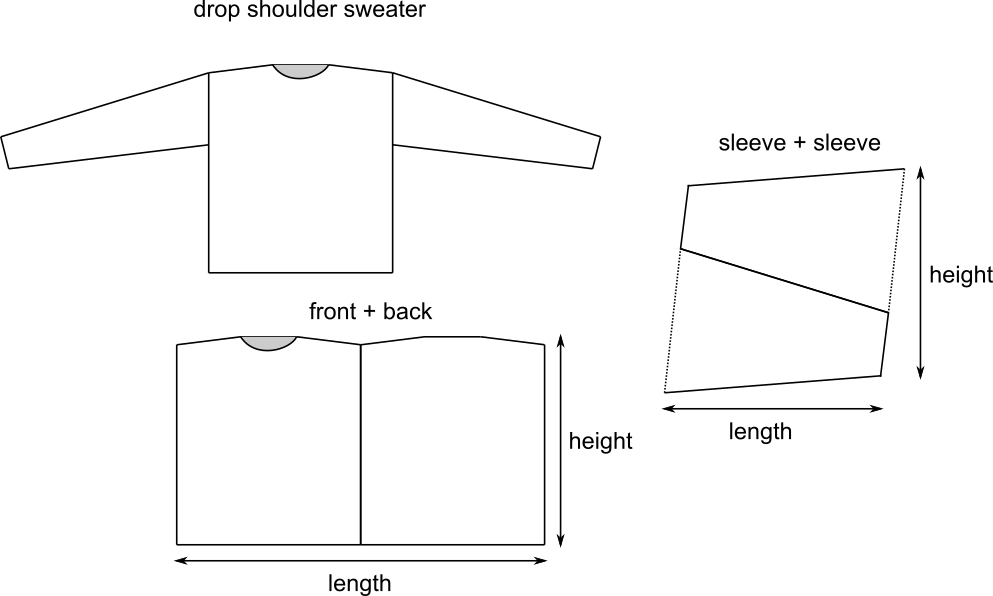
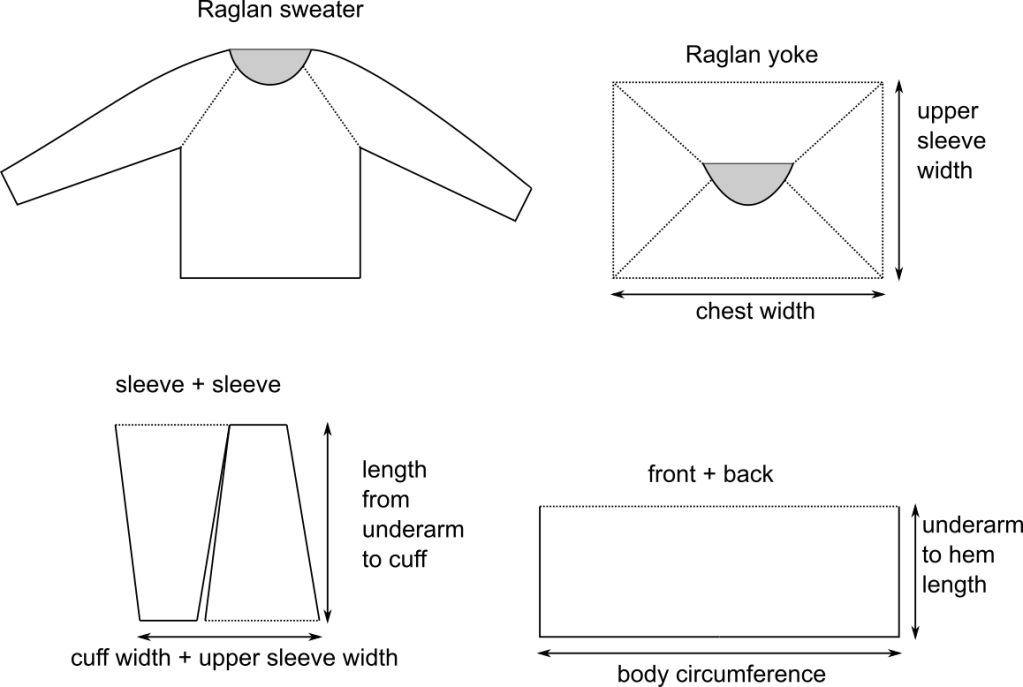
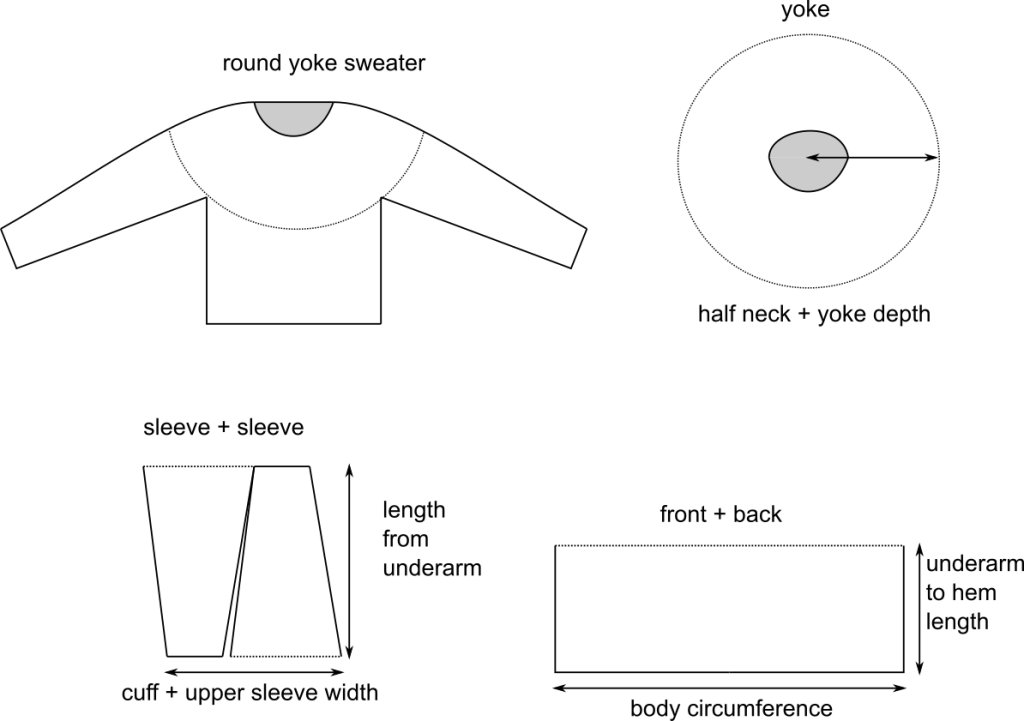
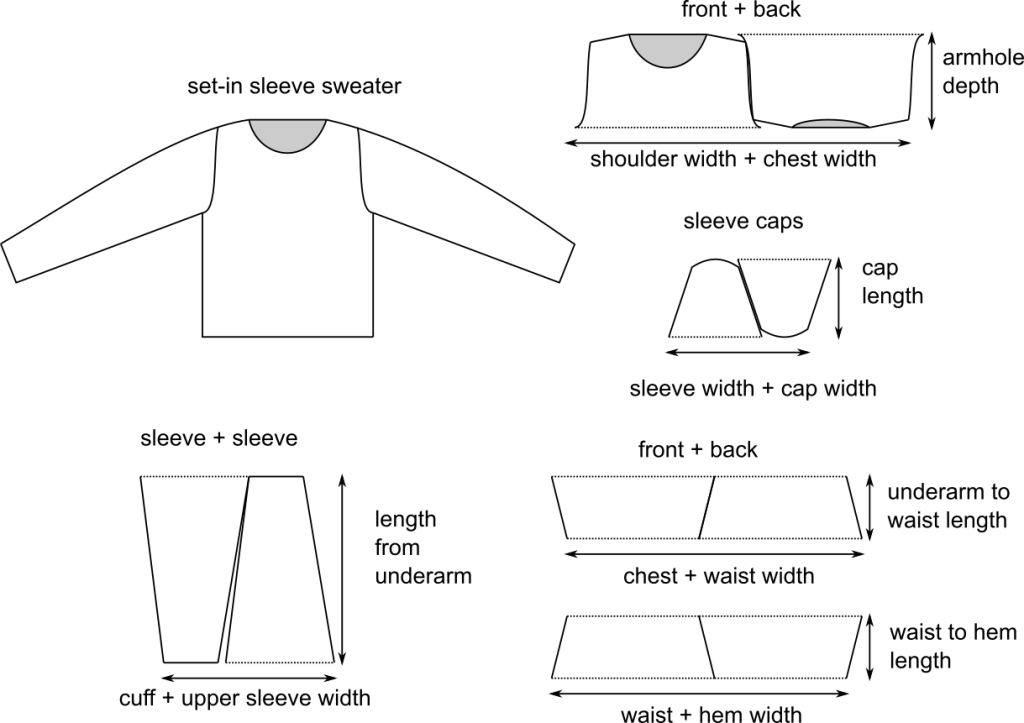
    To find the area of an entire sweater I reduce the design into simple shapes like rectangles and parallelograms as shown in the illustrations below, and multiply the length by the height to find the area of each shape.

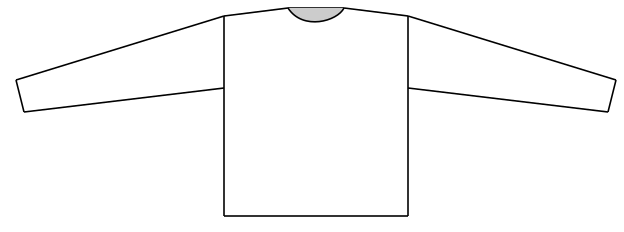
    Drop Shoulder

    A line drawing of a drop shoulder sweater showing how the sleeves and body can be reduced to parallelograms and rectangles.

    A drop shoulder sweater is the simplest design for finding the area. The front and back are rectangles and there are two trapezoids for the sleeves. Add the length and width of the two sleeves together to make one parallelogram. If there is a collar it is probably a rectangle also, and you can add the length to the height to find its area.

    Raglan Yoke

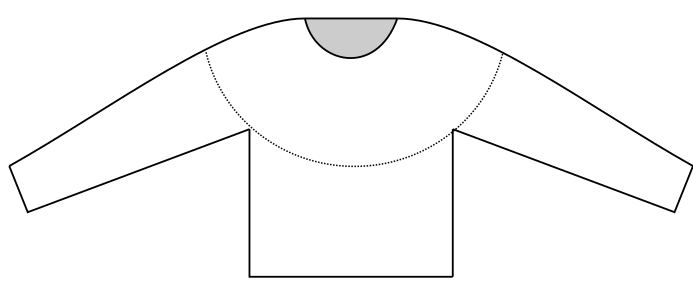
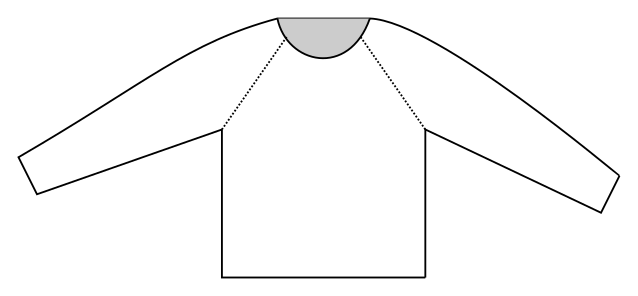
    A line drawing of a raglan sweater showing how the yoke forms a square.

    If you take a raglan sweater off the needles at the underarm and lay it out flat you’ll see how the yoke can be simplified into a rectangle. Multiply the chest width by the upper sleeve width before the underarm cast on to find the area of the yoke. Unless it’s a deep V or a scoop neck I don’t subtract anything for the neck. This just adds a little buffer to the yardage. The area of the body below the underarm and the sleeves below the shoulder can be calculated in the same way as the drop shoulder sweater.

    Round Yoke

    A line drawing of a round yoke sweater showing how the yoke forms a circle, and how the sleeves, front, and back form rectangles when combined.

    For round yokes, first determine the radius of the yoke by adding half the neck width to the yoke depth, square the radius, then multiply by pi. This will give you the area of the yoke. The area of the sleeves and the body below the underarms will be the same as the raglan sweater.

    Set-In Sleeve

    A line drawing of a set-in sleeve sweater, and illustrations of all the sweater parts.

    A set-in sleeve sweater will have a few more shapes than the others. The sleeve caps can be treated as trapezoids the same way as the sleeves and added together to create one parallelogram. The body of the sweater below the underarms can still be treated as two rectangles, but if there is significant waist shaping you may wish to break the top and bottom into trapezoids and add them together. The yoke can also be treated as a trapezoid, and adding the front and back together will make a parallelogram.

    After you have determined the area of your sample you can find how many grams of your yarn it takes to make 1 square inch of your fabric by dividing the area of the sample by the weight of the sample. You can then multiply the grams per square inch by the total area of every other size in your pattern. This will tell you how much of that particular yarn it takes to make each size by weight, but you should also convert the weight into yards to make the estimate useful to knitters who want to use a different yarn.

    Using the information from the ball band of your sample yarn, divide the weight of one skein by the yards per skein to find the yards per gram, then multiply the yards per gram by the weight of each size. This will give you the yardage needed for each size. You can also estimate the number of skeins needed for each size by dividing the total weight by the weight of one skein and rounding up to the nearest whole number.

    You can see from the illustrations above that the area measurements are not exact, and each knitter’s tension will affect the amount of yarn used also. These are only estimates, but you want to be sure that your knitters will not run out of yarn before completing their projects, so it is a good idea to add a buffer to the recommended yardage, which is usually 10%, but could be more or less depending on the design.

    Estimating yardage is just one of the tech editing services I offer. Yardage estimates are included with every grading job I do, but I can also check your yardage estimates or calculate the yardage for you when I tech edit your pattern. Just let me know that’s a service you’re interested in and tell me the size and weight of your sample. I would love to know what you think of this method of estimating yardage in the comments!

    Thank you for knitting!